Alternatives
AI Humanizer Vs Watermark Remover
AI humanizer vs watermark remover is a distinction worth getting right, because the two products are sold interchangeably and do entirely unrelated things.
One changes how text reads. The other deletes data from a file. Only one of them has any bearing on a statistical watermark, and it is not the one named after the job.
Humanizers rewrite and so may weaken text marks. Removers strip files and cannot touch text marks.
Runs in your browser. No signup, no upload, nothing stored.
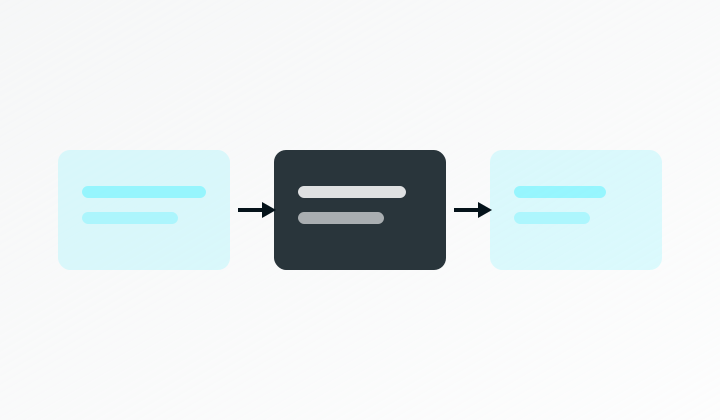
What a humanizer does
It rewrites text to score lower on AI-writing classifiers, by varying sentence length, swapping vocabulary and deliberately introducing irregularity.
Because it rewrites, it incidentally does the one thing that affects a statistical watermark: it changes the token choices. That is an accident of the method rather than its purpose.

What a watermark remover does
It deletes data — metadata blocks from files, or invisible characters from text.
Both operations are real, fast and verifiable. Neither has any effect whatsoever on a mark carried by the words themselves, because there is no data to delete.
The counterintuitive conclusion
For the Claude text watermark, the humanizer is closer to the right tool — not because it targets the mark, but because rewriting is the only thing that touches it at all.
The product named after the job does not do the job. The product named after something else does it by accident. That is a strange state of affairs and it is genuinely where the category sits.
Two cautions on humanizers
They carry costs that the marketing tends not to mention:
- Output often reads worse — irregularity is added on purpose
- Meaning drifts, and any error introduced becomes yours on publication
- If it runs on another marked model, you may be swapping one mark for another
- Classifier scores are not watermark detection, so a good score proves nothing here
The metric problem
A humanizer optimises for a classifier score, and classifier scores are not measuring provenance. They are measuring how machine-written the prose sounds.
So you can drive that number to zero and change nothing about the watermark, or weaken the watermark substantially and see the number barely move. The two quantities are unrelated, and treating one as a proxy for the other is the mistake.
What to use when
If you have a file, use a metadata stripper — it is the correct tool and the result is checkable.
If you have text and a real reason to reduce the mark, rewrite it substantially yourself, or paraphrase and then edit hard. Either way, budget the editing time rather than trusting the output as it arrives.
Source
The claims on this page are drawn from primary documentation and reporting rather than from other tools’ marketing copy.
Anthropic: How Claude marks AI-generated content →Related
Check what your text and files actually carry
Runs in your browser. No signup, no upload, nothing stored.