Remove
Remove C2PA Metadata From Claude Images
Remove C2PA metadata from Claude images and, unlike the text watermark, you can actually prove the result.
Provenance metadata is a readable block inside the file. You can inspect it before, strip it, and inspect it again afterwards.
Strip the manifest block at byte level. Pixels stay bit-for-bit identical and the claim is gone.
Runs in your browser. No signup, no upload, nothing stored.
What Claude attaches to files
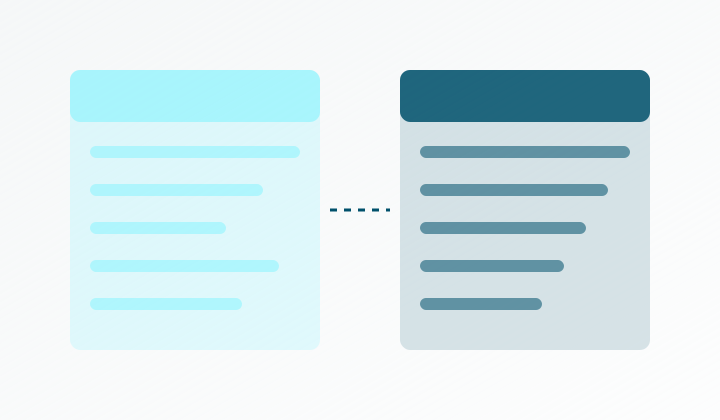
For supported file types — .svg, .png and .jpg — Anthropic attaches signed provenance metadata following the C2PA open standard.
The manifest records that Claude processed the file and is cryptographically signed, so later tampering with the claim itself becomes detectable.
Note the boundary carefully: the signature protects the claim's integrity. It does not prevent someone deleting the whole block, which removes the claim rather than breaking it.

Where it physically lives
C2PA data is stored in each format's standard metadata container, which is why removal is deterministic rather than a matter of guesswork:
- JPEG: a JUMBF box behind the APP11 marker
- PNG: a dedicated caBX chunk, plus XMP packets in iTXt
- SVG: an embedded XML metadata element
Three ways to remove it
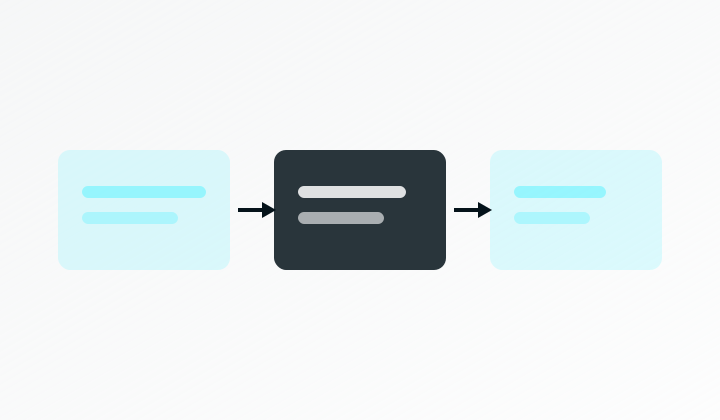
Byte-level stripping removes the manifest and leaves the image data untouched, so the picture is unchanged in every measurable way. This is the correct method.
Re-encoding the image drops metadata as a side effect, but recompresses and therefore degrades it.
A screenshot discards everything, at the cost of resolution, colour fidelity and often the alpha channel. It works, and it is the worst of the three.
Verification is the part you can actually do
Read the file's metadata blocks before and after. If the manifest is gone, it is gone, and no interpretation is required.
This is the sharpest contrast with the text watermark, where no public detector exists and nobody can confirm anything at all.
Absence does not prove much
Files lose metadata constantly through ordinary handling. Messaging apps strip it, social platforms re-encode on upload, and screenshots discard it entirely.
So an image that genuinely came from Claude may arrive with no manifest for completely innocent reasons. Checking tells you what this particular copy carries, and nothing about its history.
One thing worth weighing first
C2PA is a provenance record, not a restriction. Removing it strips information about where a file came from rather than unlocking anything.
If you are publishing somewhere with disclosure rules, or under terms that require provenance to survive, stripping it may put you offside regardless of how the file looks.
Source
The claims on this page are drawn from primary documentation and reporting rather than from other tools’ marketing copy.
C2PA technical specification →Related
Check what your text and files actually carry
Runs in your browser. No signup, no upload, nothing stored.